


Most countries are approaching AI strategy backwards.
They start with applications. A chatbot here, an automation pilot there, perhaps a national programme with funding attached. It creates the appearance of progress, but it misses the point.
AI is not a product category. It is layered infrastructure. More than that, it is becoming foundational to how economies produce, how states govern, and how power is exercised.
This is a general-purpose technology in the same class as electricity or the internet. It will shape productivity, military capability, financial systems, information flows, and social organisation. States that control it will compound advantage across every sector. States that depend on others for it will find their growth, security, and decision making increasingly constrained.
And that’s why getting the strategy right is so crucial to the future of every country.
The question is not whether a country adopts AI. Every country will. The question is whether it builds enough control over the stack to avoid strategic dependence.
What does independence actually mean?
Full self-sufficiency across every layer is unrealistic in the near term. Even the most advanced economies rely on global supply chains.
But there is a difference between participation and dependence.
A country is dependent when it cannot operate critical systems without external permission. That is the line that matters.

If compute can be restricted, models can be withdrawn, or data sits in systems controlled elsewhere, then AI capability is conditional. Under pressure, it can be limited or switched off.
So the objective is not abstract “ownership of everything.” The objective is more precise. A state must ensure that no single country or supplier can choke off its AI capability.
That requires three forms of control.
1. Direct control over critical layers.
2. Supply chain control through diversification and secured access.
3. Substitution control, the ability to switch suppliers quickly when needed.
The stack, properly understood
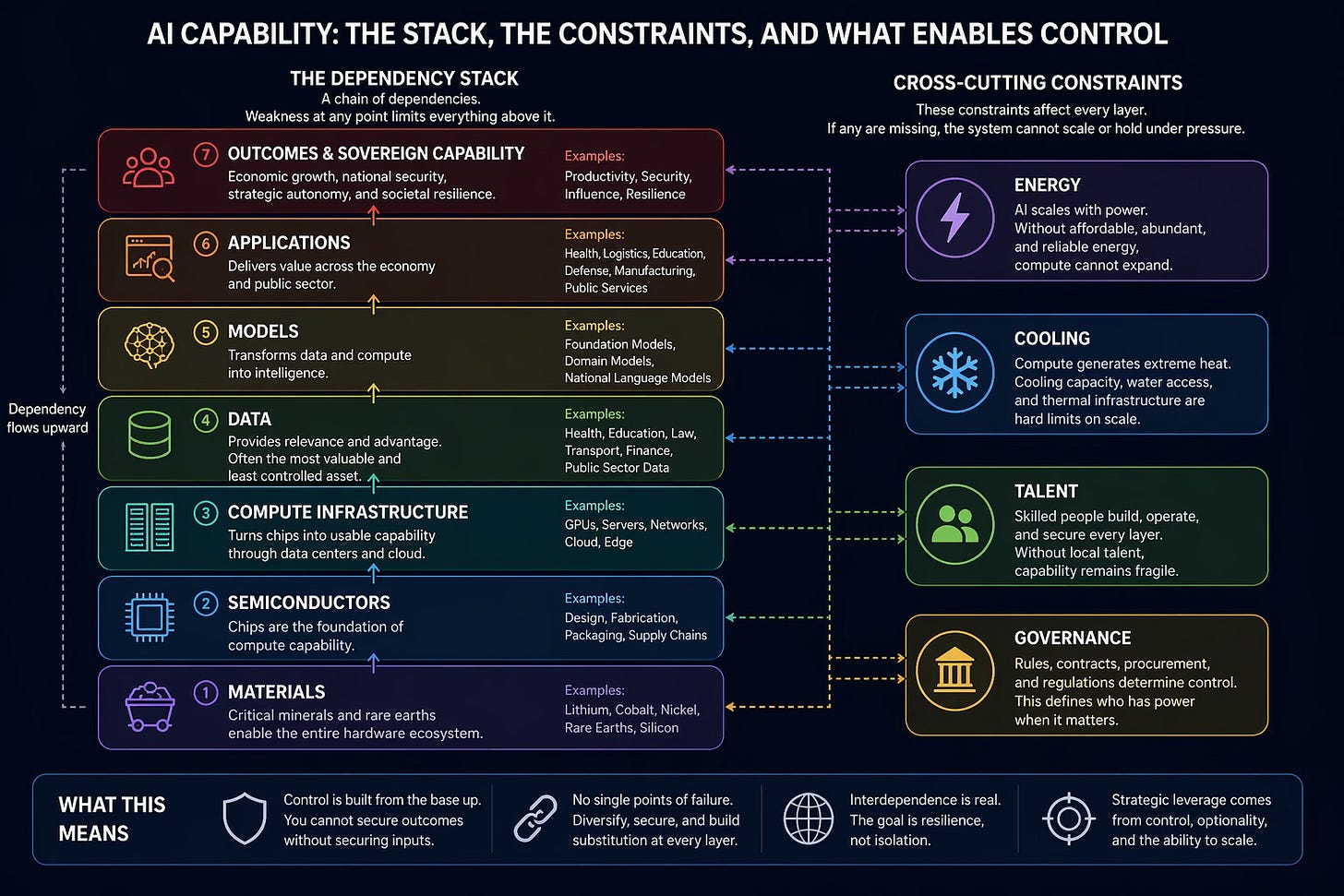
Once framed correctly, the AI system is not a loose set of layers. It is a chain of dependencies, where weakness at any point limits everything above it.
1) Materials – Rare-earth And Other Minerals.
At the base sit critical minerals and rare earths. These underpin semiconductor production and broader hardware systems. Control here is not just about extraction but about processing and refinement. Without that, upstream ownership is incomplete.
2) Semiconductors
Compute capability ultimately depends on chips. Design, fabrication, packaging, and supply chains determine who can build and scale AI systems. Most countries will not control the full stack, but having no position at all creates strategic exposure, particularly in a sector where access can be restricted for geopolitical reasons.
3) Compute
This is where those inputs are converted into usable capability. Data centres, GPU clusters, and cloud infrastructure determine how much AI a country can actually run. If this layer sits entirely on foreign infrastructure, then capability is rented regardless of upstream access.
Outside the United States and China, very few countries possess companies with the scale of Google, Microsoft, Alibaba, or Tencent.
4) Data
Data gives systems relevance and advantage. National datasets in health, education, law, and infrastructure shape how models behave. If these are processed or embedded externally, value and control move with them.
National datasets should be treated as strategic assets, not commodities. Once embedded in external systems, both value and control are difficult to recover.
5) Models
Models translate compute and data into intelligence. The strategic objective is not global dominance, but control over systems that operate within national language, legal, and institutional contexts.
6) Applications
This is where value is realised across the economy. Productivity gains, automation, and decision systems all sit here, but they are downstream of every layer above.
The cross-cutting constraints
These are not layers. They are constraints that determine whether the system scales or fails.
a) Energy
AI scales with power consumption. Without abundant and reliable energy, compute cannot expand.
b) Cooling
This is now a hard constraint, not an operational detail. High performance compute generates extreme heat. Cooling systems, water access, thermal engineering, and data centre design directly limit how much compute can be deployed. Countries that ignore this will hit physical limits before strategic ones.
c) Talent
Every layer depends on human capability. Design, operation, optimisation, and security all require a domestic skills base.
d) Governance
This determines control under pressure. Contracts, procurement, and regulatory frameworks decide whether the system can be constrained externally.
AI capability is often described in terms of models and software. It is constrained by physics, supply chains, and infrastructure. Compute is not an abstract resource. It is the output of materials, semiconductors, energy, and cooling systems working together. Control at the software layer without control of these upstream inputs creates an illusion of capability rather than real independence.
What should be owned, secured, and diversified
Not every layer requires the same approach. Some must sit under direct control:
Core data systems, domestic compute capacity, critical public sector AI, and national language capability fall into this category.
Some require supply chain control:
Semiconductors, energy inputs, and critical materials must be secured across multiple sources, with long term agreements and strategic reserves.
Some require substitution capability:
Cloud providers, model providers, and parts of the global tooling ecosystem should never become single provider dependencies.
The mistake is treating all layers the same. Strategy lies in deciding where control is essential and where flexibility is sufficient.
The semiconductor reality
Semiconductors are the hardest constraint and the area where most strategies become unrealistic.
No country outside a small group will build a full leading edge semiconductor stack in the near term. Attempting to do so immediately is a misallocation of capital.

But doing nothing is equally dangerous. The correct approach is layered.
In the short term, we advise governments to secure supply through multi country sourcing, long term agreements, and strategic stockpiles.
In the medium term, build capability in the middle of the stack. Advanced packaging, assembly and testing, AI server manufacturing, cooling systems, and infrastructure integration. These areas provide real leverage and are accessible.
Alongside this, develop domestic design capability. Chip design talent and state backed design houses create long term optionality.
Only over time should countries move toward selective fabrication, and even then, not necessarily at the leading edge. Mature nodes, power systems, and specialised chips are far more realistic entry points.
This is how a semiconductor position is built without chasing prestige at the expense of substance.
Rare earths and materials
Control over inputs does not stop at chips.
Critical minerals and rare earths underpin the entire system. The mistake most countries make is focusing only on extraction.
The strategy has three parts.
1. Secure upstream access through equity stakes and long term supply agreements.
2. Build domestic processing and refining capability, where much of the real control sits.
3. Establish strategic reserves to buffer against disruption.
Without processing capability, ownership at the mine level is incomplete.
Energy as the anchor
Energy is not just an advantage. It is the foundation.
AI infrastructure scales with power consumption. Data centres, training clusters, and inference systems all depend on stable and affordable energy.
States that can overbuild capacity, lock in long term pricing, and align energy policy with compute expansion will have a structural advantage.
For energy rich countries, this is a direct lever. For others, it requires deliberate planning across grid stability, generation mix, and industrial pricing.
The missing layer: national champions
Most countries face a structural gap. They do not have large domestic technology firms capable of building and operating cloud, compute, and AI platforms at scale.
Without this, they remain customers in the system, or tenants within someone else’s system
The solution is not to wait for such firms to emerge organically; they must be built.
Therefore, a focused approach is required. A focussed approach is required:
· Select a small number of national champions in areas such as cloud infrastructure, AI platforms, and sector specific applications.
· Guarantee demand through government procurement and national projects.
· Provide advantages in access to compute, data, and capital.
· Allow competition to develop later, once capability exists.
Every successful technology ecosystem has followed some version of this path, irrespective of ideology or government system.
Cloud and compute in practice
Most “sovereign cloud” strategies fail because they are built on a single foreign provider with local branding.
That is managed dependence. A more robust model combines domestic and external capacity.
Domestic compute clusters provide assured capability for government, research, and strategic industry.
Foreign cloud partnerships provide scale and access to global tooling.
Workloads should be separated based on sensitivity.
At the same time, systems should be designed to avoid lock in. Multi provider architectures and clear exit pathways ensure substitution remains possible.
The objective is not in isolation. It is control under pressure – allowing for national companies to grow in expertise, maturity and confidence.
Conclusion
A country does not need to control every component of the AI stack immediately.
But it must ensure that no external actor can restrict its ability to operate, adapt, and scale its systems.
That means removing single points of failure, securing critical inputs, building domestic capability in key layers, and maintaining the ability to switch when required.
If those conditions are met, the system holds. If they are not, then apparent capability will collapse under pressure.

